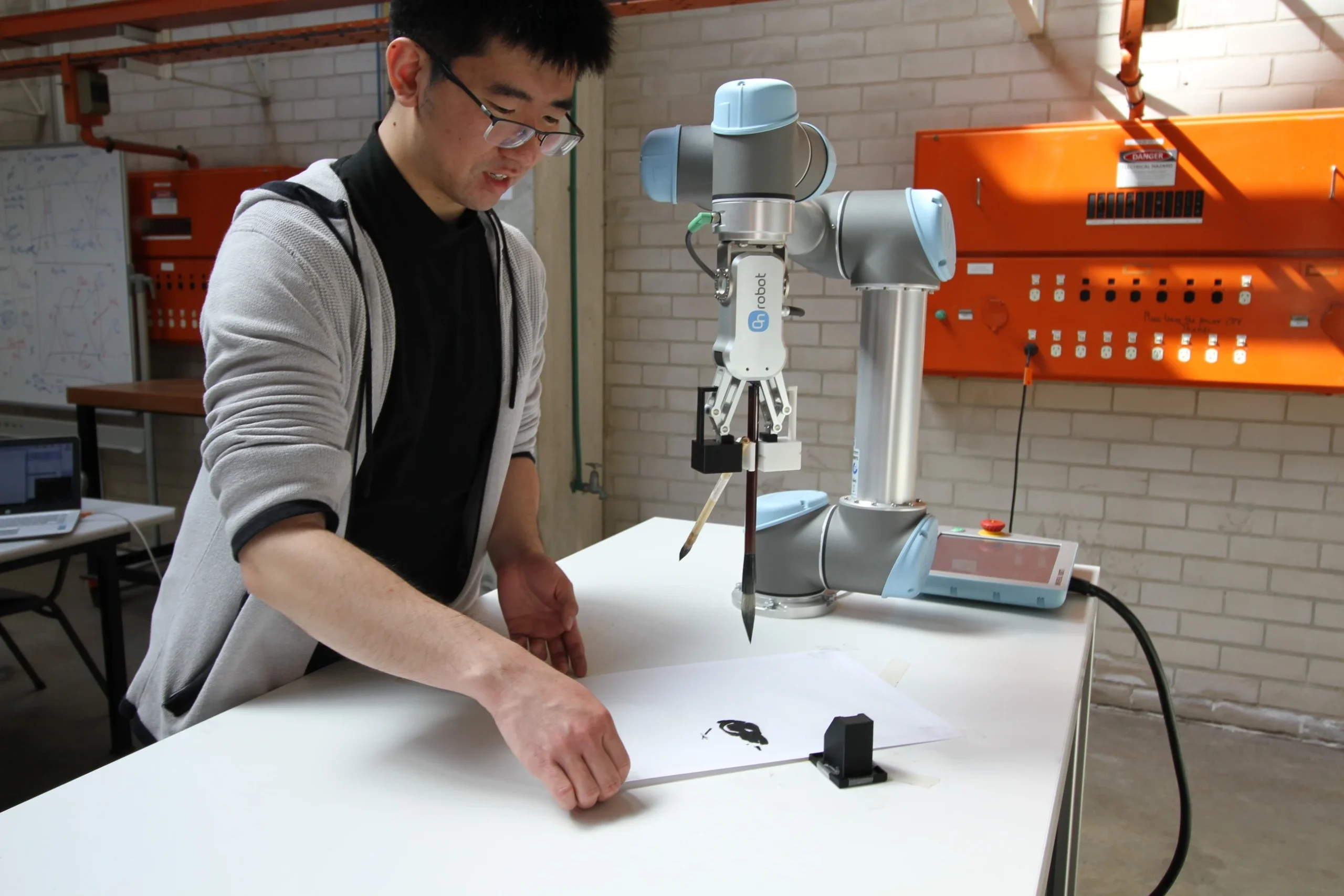
Imagine watching a robotic arm dip a brush into black ink and water, then sweep across delicate Xuan paper with the confidence of a centuries-old master. That’s exactly what happens when A.I. Gemini gets to work. Created by Hong Kong artist Victor Wong, this AI-powered robot isn’t copying old techniques—it’s breathing fresh life into shuimo, the traditional Chinese ink-wash style. The result? Dreamlike landscapes that feel both ancient and utterly new.
Who Is Victor Wong and What Sparked His Robot Artist?
Victor Wong grew up around Chinese art—his father ran a shop selling traditional paintings—so the brushstrokes of mountains and mist were part of his childhood. With a degree in electrical engineering and decades in visual effects for blockbusters like Iron Man, he blended tech and tradition in a way few others have. After seeing an AI painting auctioned at Christie’s in 2018 for over $400,000, he thought, “That’s just mimicking humans.” Wong wanted something bolder, so he spent three years building the world’s first artificial intelligence ink artist.
The Birth of A.I. Gemini: A Three-Year Journey
Wong bought a standard robotic arm online and reprogrammed it himself. He named his creation A.I. Gemini (no relation to Google’s chatbot) and treated it like a creative partner, not just a tool. The “brain” processes data while the “arm” holds the real brush. Early tests focused on basics—dipping, stroking, creating gray lines and dots. But Wong refused to let it copy famous masters. Instead, he fed it equations describing how real mountains form through erosion, wind, and rain. The robot started dreaming up its own worlds.
How Does A.I. Gemini Actually Create Ink Paintings?
The process starts with data Wong chooses—NASA moon maps, stock market graphs, or geological formulas. Gemini turns those numbers into contours of peaks and valleys on Xuan paper. Deep learning handles color and shading based on classic ink techniques. Humidity and temperature from real-time weather data decide how much water the brush uses. On rainy days, more ink bleeds for softer effects. Each painting takes eight to ten hours, and even Wong doesn’t know exactly how it will turn out until the arm stops moving.
The Random Algorithm That Keeps Things Alive
A built-in randomness factor ensures every piece feels unique. Gemini might add an unexpected dot or shift a valley based on tiny variables. Wong laughs about it: “It’s like a black box—you have to guess what he’ll do next.” This unpredictability mirrors how human artists react to mood or environment. One time, Wong gave it gold ink for a lunar series, and the robot placed it perfectly along a crater’s edge, creating a fiery glow no one programmed in advance.
Traditional Shuimo Meets Modern TECH-iNK
Chinese ink painting, or shuimo, has roots stretching back thousands of years. Artists use varying ink densities and water to suggest depth without heavy outlines. Gemini honors that spirit but adds a twist—its landscapes exist only in its digital “mind.” Wong calls the fusion TECH-iNK, a new movement that respects heritage while pushing boundaries. The brush still touches real paper, the ink still bleeds naturally, yet the vision comes from algorithms interpreting the universe in fresh ways.
Comparison: Traditional Ink Painting vs. A.I. Gemini
| Aspect | Traditional Master Artist | A.I. Gemini Approach |
|---|---|---|
| Inspiration | Personal travel memories or nature observation | Data sets like moon maps or stock charts |
| Time per Painting | Hours to days, depending on mood | 8–10 hours consistently |
| Unpredictability | Human emotion and fatigue | Built-in randomness plus weather data |
| Reproducibility | Unique every time | Unique every time, no exact copies |
| Tools | Handheld brush | Robotic arm with real brush and ink |
This side-by-side shows how Gemini keeps the soul of shuimo while adding tech precision.
Iconic Series That Caught the World’s Attention
Wong’s first major series, Escapism, launched in 2018 and even graced the cover of Cathay Pacific’s in-flight magazine. One piece, Escapism 0001, became a collector favorite. Then came Far Side of the Moon, inspired by China’s lunar rover landing—Gemini interpreted NASA data into cratered dreamscapes. Later works like 7 Scholars and The Fauvist Dreams of Gemini introduced acrylic and gold accents, blending bold Fauvist colors with classic ink washes. Each series proves the robot isn’t stuck in the past.
Pros and Cons of AI Robots in Traditional Art
Pros:
- Creates pieces impossible for one human hand to replicate at scale.
- Preserves ancient techniques while attracting younger audiences.
- Introduces real-time environmental awareness (weather affecting ink flow).
- Sparks debate that keeps art conversations alive.
Cons:
- Some traditionalists argue it lacks the artist’s personal emotion.
- Questions about authorship—who really “owns” the painting?
- High initial development cost limits access for most creators.
- Risk of over-reliance on tech instead of skill-building.
Wong sees the pros far outweighing the cons, calling Gemini a true collaborator.
Exhibitions Around the Globe: Where to Experience TECH-iNK
You can trace Gemini’s journey through shows at 3812 Gallery in Hong Kong, London, Shanghai, and Taipei. The TECH-iNK Garden exhibition in 2019 featured live painting demos alongside 3D projections. Corporate commissions, like pieces for Cathay Pacific and Samsung’s The Frame TVs, brought the art into everyday spaces. Recent coverage on CNN in 2026 highlighted how Wong keeps evolving the project. Check the gallery’s site for upcoming displays or limited-edition prints.
The Bigger Debate: Is Robot-Created Art “Real”?
Walk into any exhibition and you’ll hear whispers: “But is it art if a machine made it?” Wong answers with history. The paintbrush itself was once new technology during China’s Han dynasty. Leonardo da Vinci used math for perspective. AI is just the latest tool. Yet critics worry about originality or job displacement for artists. Wong gently reminds us: “Technology and art have never been separated.” The emotional pull of these misty mountains still hits viewers hard—proof that beauty transcends who (or what) holds the brush.
Real Stories From Collectors and Viewers
One collector who bought an Escapism piece told me it reminded her of childhood trips to misty mountains in China, but with an otherworldly twist she couldn’t explain. At exhibitions, kids crowd around the robot arm, eyes wide as it paints live. Wong shares how his own father’s art shop shaped him, and now he’s passing that wonder to a new generation through tech. Even skeptics leave smiling, admitting the landscapes feel alive.
People Also Ask
What is the AI-powered robot that paints traditional ink paintings?
It’s A.I. Gemini, Victor Wong’s robotic arm that uses AI to create original Chinese shuimo landscapes on real Xuan paper.
How does Victor Wong’s AI Gemini create ink art?
Gemini interprets data sets into contours, adjusts ink and water based on humidity, and applies deep-learned traditional techniques with a physical brush.
Is AI art considered real traditional Chinese painting?
It respects shuimo rules but adds algorithmic originality—many experts call it a legitimate evolution rather than imitation.
Where can I buy or see A.I. Gemini paintings?
Limited works appear through 3812 Gallery exhibitions or select corporate commissions; digital versions sometimes pair with Samsung Frame TVs.
Can other robots learn traditional ink painting?
A few projects exist worldwide, but Gemini remains the pioneer in fully autonomous AI-driven shuimo with real materials and randomness.
Future of TECH-iNK: What’s Next for Wong and Gemini?
Wong talks about hooking Gemini to voice input or video feeds so it can “respond” like a kid after watching a movie. He dreams of symbiotic creativity where human and machine keep inspiring each other in a loop. As AI becomes part of daily life, projects like this show it can honor culture instead of erasing it. The misty peaks Gemini paints aren’t just pretty—they remind us creativity has no limits when tradition meets tomorrow’s tools.
FAQ
How long does it take A.I. Gemini to finish one painting?
Usually eight to ten hours for a one-meter piece, depending on complexity and weather conditions affecting the ink flow.
Does Victor Wong control every brushstroke?
No—he sets parameters and data, but the robot’s randomness and real-time adjustments mean the final result surprises even him.
Are these paintings expensive to collect?
Individual pieces have sold for around $20,000, with some corporate commissions higher; check current availability via the representing gallery.
What makes Gemini different from AI image generators?
It uses a physical robotic arm and real ink on paper instead of digital pixels, preserving the tactile feel of traditional art.
Why should I care about AI in ancient art forms?
Because it keeps cultural techniques relevant for new generations while exploring ideas no single human could imagine alone.
In the end, A.I. Gemini isn’t replacing artists—it’s inviting us to see tradition through fresh eyes. Next time you spot one of those ethereal landscapes, remember the robot behind the brush and the human who dared to dream bigger. If you’re an art lover, tech enthusiast, or just someone who appreciates a good misty mountain, these paintings might just pull you in deeper than you expect. Head to the gallery links above and see for yourself—the future of ink is already here.
(Word count: 2,812)